
5 Awesome Forgejo Alternatives
 Yulei Chen
Forgejo is a community-driven, open-source Git forge and a soft fork of Gitea. It's lightweight, written in Go, and ships everything you need for code hosting: pull requests, issues, wikis, a container registry, package registry, and even GitHub Actions-compatible CI via Forgejo Actions. Forgejo is completely free and backed by the non-profit Codeberg e.V., so there's no cloud pricing to worry about.
If you want a private instance with your own domain and full control, self-hosting is the way to go. You can deploy Forgejo on Sliplane for just €9/month per server, with one-click setup, HTTPS, and persistent storage included. Check out our easy deploy guide to get started in minutes.
But maybe Forgejo doesn't quite fit your workflow. Maybe you need built-in CI/CD without Actions, enterprise compliance features, or something even more minimal. Let's look at 5 awesome alternatives.
1. Gitea
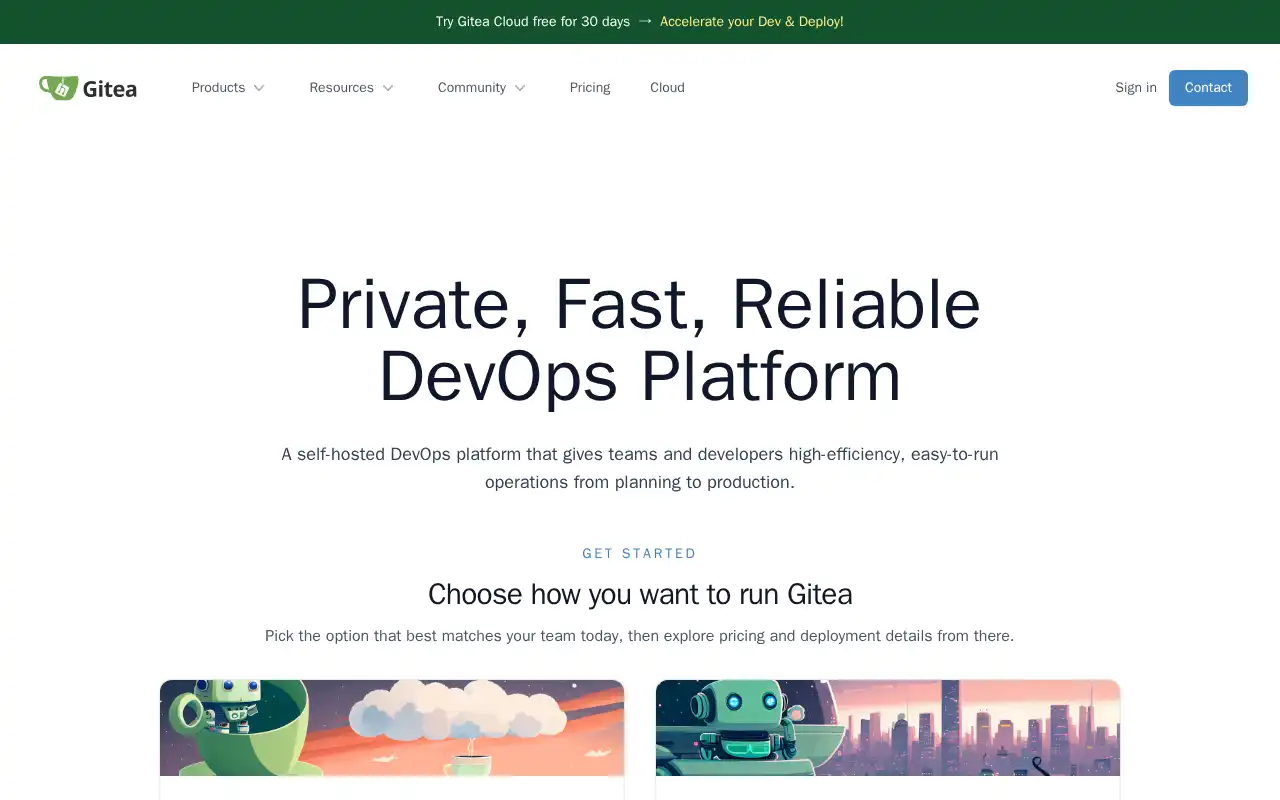
Gitea is the project Forgejo was originally forked from. It's a lightweight, self-hosted Git service with a GitHub-like interface, built-in CI/CD (Gitea Actions), a package registry, and project management features. Gitea and Forgejo share 99% of their codebase, so migrating between them is straightforward.
- Features: GitHub-like UI, pull requests, issues, milestones, Gitea Actions (CI/CD), built-in package registry, organizations and teams, OAuth2 provider, webhooks, LFS support, and migration tools for GitHub/GitLab/Bitbucket repos.
- Why You Should Use It: If you want the largest ecosystem and fastest feature development in the lightweight Git forge space, Gitea is the pick. It has more third-party integrations, a bigger community, and Gitea Cloud offers managed hosting if you don't want to maintain servers yourself. The Enterprise tier adds SAML SSO, audit logs, and priority support.
- Why Not: Gitea Ltd. was incorporated without full community input, which is exactly why Forgejo was created. If community governance and GPL licensing matter to you, Forgejo is the better choice. Gitea's MIT license also means forks can go proprietary.
- Pricing: Open source and free to self-host (MIT license). Gitea Cloud offers a 30-day free trial, then pricing varies by plan. Enterprise self-managed runs $9.50-$19/user/month. Third-party managed hosting (e.g., HostedGitea) starts around $24/month.
2. GitLab CE

GitLab is the heavyweight of self-hosted Git platforms. The Community Edition (CE) is free and open source, offering a full DevOps platform with Git hosting, CI/CD pipelines, container registry, security scanning, and project management, all in one package.
- Features: Complete CI/CD with Auto DevOps, container registry, issue boards, merge requests with approvals, wiki, snippets, built-in security scanning (SAST, DAST, dependency scanning on Ultimate), Kubernetes integration, and a massive ecosystem of integrations.
- Why You Should Use It: If you need an all-in-one DevOps platform that covers everything from code to production, GitLab is unmatched. It's the go-to for teams that need compliance features, advanced CI/CD, and enterprise-grade security scanning. The Community Edition alone gives you more built-in CI/CD power than any lightweight forge.
- Why Not: GitLab is resource-hungry. You'll need at least 4 GB of RAM and 4 CPU cores for a comfortable experience, compared to Forgejo's ~420 MB idle footprint. Upgrades can be complex, and the free tier limits you to 5 users per group. It's overkill for small teams or personal projects.
- Pricing: Community Edition is free to self-host. GitLab.com SaaS Free tier is $0 (5 users max). Premium starts at $29/user/month (SaaS) or $19/user/month (self-managed). Ultimate requires custom pricing through sales.
3. Gogs
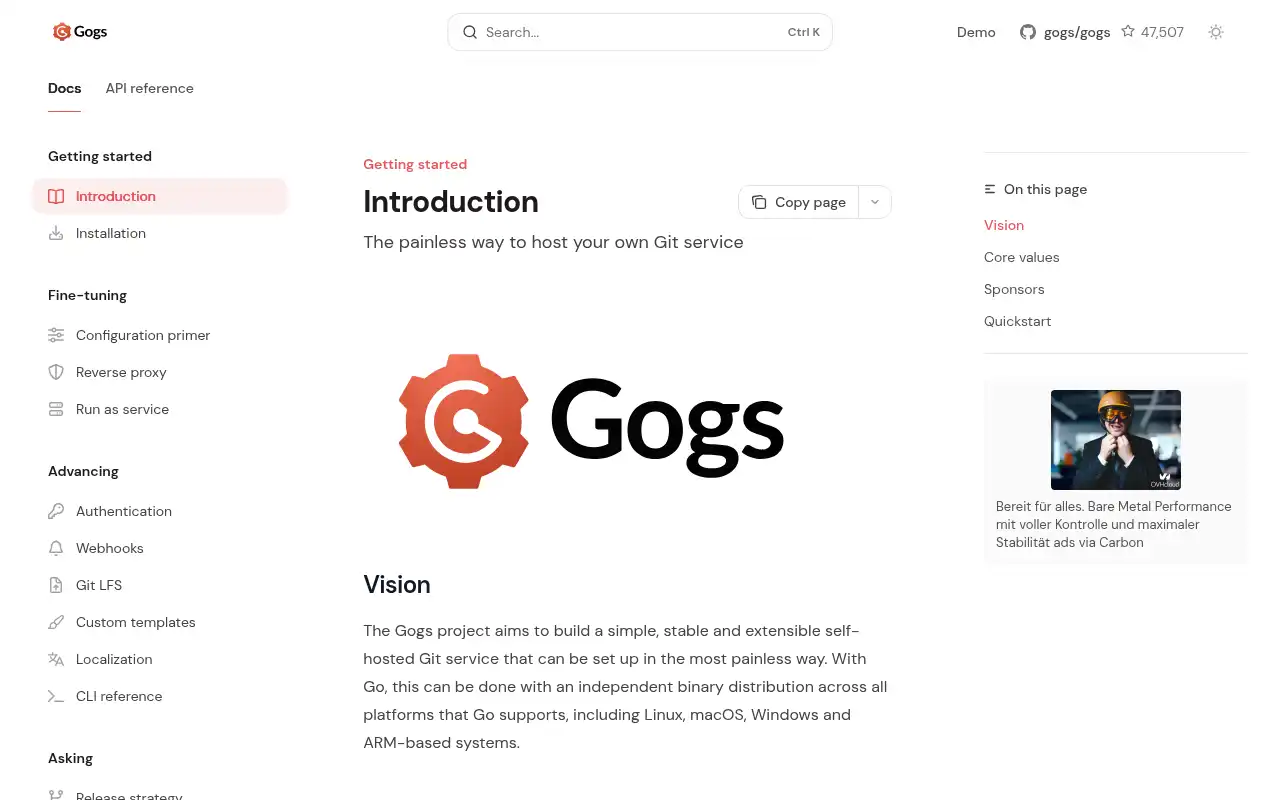
Gogs is the original "painless self-hosted Git service" that inspired both Gitea and Forgejo. Written in Go, it ships as a single binary and runs on as little as 64 MB of RAM. If you just need a Git server and nothing else, Gogs is as simple as it gets.
- Features: Repository management with SSH and HTTPS, pull requests, issue tracking, wikis, webhooks (Slack, Discord, Teams), organizations and teams, LDAP/SMTP/OAuth2 authentication, multiple database backends (SQLite, MySQL, PostgreSQL, MSSQL), and a built-in admin panel.
- Why You Should Use It: If your only requirement is "host Git repos and don't think about it," Gogs is the answer. It can run on a Raspberry Pi or a $5 VPS for months without any maintenance. The single-binary deployment means there's almost nothing to configure or break. It's battle-tested and stable.
- Why Not: Gogs has a much slower release cadence and smaller community than Forgejo or Gitea. It lacks built-in CI/CD, a package registry, and GitHub Actions compatibility. Advanced features like signed commits verification and fine-grained permissions are missing. If you need more than basic Git hosting, you'll outgrow Gogs quickly.
- Pricing: Completely free and open source under the MIT license. No paid tiers. Self-hosting costs are infrastructure-only, typically $5-10/month on a small VPS. Managed hosting through Elestio starts at $14/month.
4. OneDev
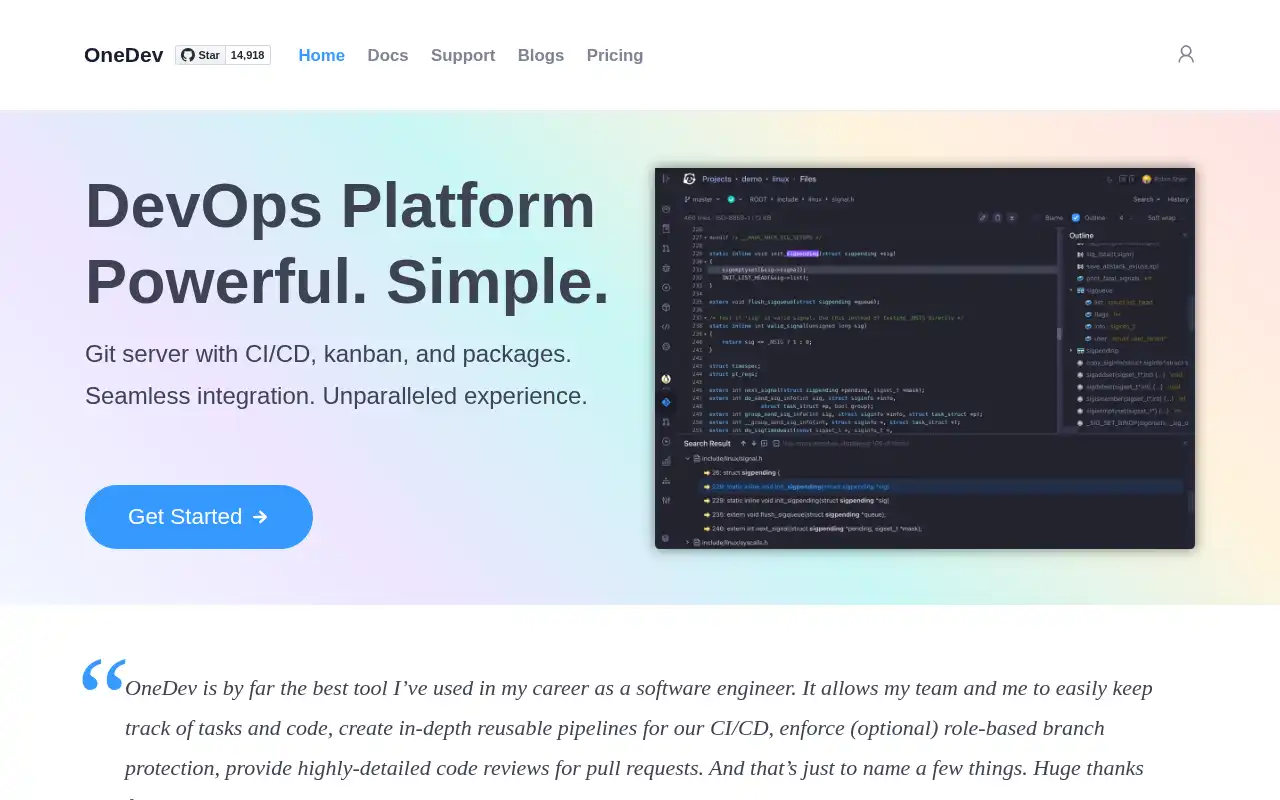
OneDev is a self-hosted DevOps platform that bundles Git hosting, CI/CD, issue tracking, Kanban boards, and a package registry into a single application. Unlike Forgejo, which relies on external runners for CI, OneDev runs pipeline steps inside Docker containers managed by the server itself.
- Features: Git hosting with code search and navigation, integrated CI/CD (no separate runner needed), issue tracking with custom fields, Kanban boards, package registry, time tracking, pull requests with inline comments, LDAP/SSO authentication, and a powerful query language for searching across issues and builds.
- Why You Should Use It: If you want code hosting and CI/CD in a single, tightly integrated package without setting up separate runners or services, OneDev is excellent. The built-in code navigation and symbol search are features you won't find in Forgejo. It's also a strong choice for teams that want project management (issues, Kanban, time tracking) alongside their code.
- Why Not: OneDev uses its own YAML format for CI/CD pipelines, not GitHub Actions-compatible workflows. The community is smaller than Gitea/Forgejo, so finding help or third-party integrations can be harder. It uses about 500 MB of RAM, which is heavier than Forgejo but still much lighter than GitLab.
- Pricing: Community Edition is free and open source (MIT license). Enterprise Edition costs $6/user/month and adds clustering, high availability, custom dashboards, AI features, and priority support. Minimum purchase is 12 user-months per order.
5. Gitness (Harness Open Source)

Gitness (now part of Harness Open Source) is a modern, open-source development platform built by Harness. It combines code hosting, CI/CD pipelines, hosted development environments (Gitspaces), and an artifact registry in a single lightweight package. It's the newest player in the self-hosted Git space.
- Features: Git hosting with pull requests, built-in CI/CD pipelines, hosted dev environments (Gitspaces), artifact registry, code search, branch protection rules, webhooks, and a modern, clean UI. The Harness platform adds feature flags, cloud cost management, and chaos engineering on paid tiers.
- Why You Should Use It: If you want a modern developer platform that goes beyond just Git hosting, Gitness is compelling. The built-in dev environments (Gitspaces) let your team spin up pre-configured coding environments instantly. It's ultra-lightweight (runs on a $4 VPS) and the UI feels fresh compared to the Gitea/Forgejo family. Great for teams that want an integrated experience without the weight of GitLab.
- Why Not: Gitness is relatively new and the community is still growing. It was rebranded from Gitness to Harness Open Source, which may signal a shift toward commercial focus. It doesn't have the maturity or ecosystem of Forgejo/Gitea, and features like federation or Actions compatibility are missing.
- Pricing: Harness Open Source is completely free to self-host. The Free cloud plan includes basic features plus 2,000 cloud credits/month. Enterprise pricing is custom (typically $23K-$41K/year for 200 employees). The open-source core covers everything most teams need.
Conclusion
| Tool | Best For | Ease of Setup | Focus | Cloud Pricing |
|---|---|---|---|---|
| Forgejo | Community-driven Git forge | Very Easy | Lightweight code hosting | Free (self-host only) |
| Gitea | Largest lightweight forge ecosystem | Very Easy | Git hosting + CI/CD | Free self-host; Enterprise $9.50-$19/user/mo |
| GitLab CE | Enterprise DevOps, compliance | Moderate | Full DevOps platform | Free CE; Premium $29/user/mo SaaS |
| Gogs | Simplest possible Git server | Very Easy | Minimal Git hosting | Free (self-host only) |
| OneDev | Integrated CI/CD + project mgmt | Easy | All-in-one DevOps | Free CE; Enterprise $6/user/mo |
| Gitness | Modern dev platform with Gitspaces | Easy | Code + CI + dev envs | Free open source; Enterprise custom |
Each tool fills a different gap: Gitea for the biggest ecosystem and cloud hosting options, GitLab CE for enterprise-grade DevOps, Gogs for dead-simple minimal Git hosting, OneDev for tightly integrated CI/CD and project management, and Gitness for a modern developer experience with built-in dev environments.
Forgejo remains a great choice for teams that value community governance, a lightweight footprint, and GitHub Actions compatibility. But if your needs lean more toward enterprise compliance, built-in CI/CD, or a full DevOps platform, one of these alternatives might be a better fit.
If you want to self-host Forgejo, check out our guide on self-hosting Forgejo the easy way.